Last week (and a half) was quite eventful, in different ways. It started out with an introduction to Ultimate Frisbee. When a friend invited me, I thought that it would be fun to try something new. Well, it was fun. I met a good group of people, and learned a new game. However, it was also disappointing. It clearly showed how out of shape I really am, despite my claims of “exercising”. That prompted me to get serious about my weight and my health again. Needless to say, I started to exercise more intensely, and I started to watch what I eat again. In a way it feels good, but it’s also hard, as my “switch” means that I won’t be able to continue to “spoil my belly” (that means that I can’t enjoy the catered food at work anymore).
As I am writing this, I am feeling very sore. On Saturday, I went for a run and worked out in the morning, and played quite a bit of ping pong in the evening. Playing table tennis was fun, as I haven’t done that in ages. For those of you who haven’t played: You’d be surprised how much you sweat once you get into it.
Last week was also a week of firsts. Surprise, surprise, I put in a solid week at work. I worked from 8-6 with an hour break for lunch, and no access to my own laptop. I hope to be able to write more about this at a later date. Next, it was the first time I got a shave at the salon. My “rough look” prompted my “stylist” to attempt to up-sell me. For 10 pin (a little over $2) extra, I could not resist. Finally, (Mom, I think someone is ringing the door bell) I rode a motorcycle for the first time in my life. (Mom, don’t worry, I’m OK). I must admit, it was FUN!
Finally, another month is coming to an end, as is evidenced by the monthly market at the Dutch Reform Church. I learned that the market dates back to the 1930s. Amazing, isn’t it? What’s also amazing is that several of the vendors know me by name now. Everywhere I go, I hear “Mr. Sam, Mr. Sam”. It’s interesting that they actually pronounce it more like the Austrians than the Americans. I’m not sure that the vendors’ knowing me is a good thing. I’ve been buying too much stuff. It has gotten to the point where I get mbasela ("bonuses"). I look at it as another way of supporting the local economy. A couple of weeks ago I went to a place where some of these crafts are made. Watching these pieces of art in the process, makes it hard to “negotiate”, especially when one knows that the few dollars difference makes a much bigger difference in the life of the vendor, than in the purchaser’s life.
Monday, August 31, 2009

Tuesday, August 18, 2009
Detachment - The Hidden Lesson
Living in Lusaka has taught me a LOT. First and foremost, as I described in the last post, I have seen the life of economically less fortunate people, which has been a true eye opener. On a more positive note, I am experiencing a different lifestyle, I am experiencing a new culture, I am making new friends, and I am part of an NGO that helps people in need. I am having fun going on trips, and seeing lots of “stuff” such as wild animals, the Victoria Falls, one of the largest waterfalls in the world (largest per water volume I believe), Lake Kariba, one of the largest man-made lakes in the world and much, much more. To top it off, my “current” level of responsibility reminds me of my childhood. Not only do I not have to worry about how to put bread on the table, I barely have to worry about dishes, as we have a maid that comes three times a week. Life couldn’t get any better than this, right?
Well, being here also has a “hidden benefit”, a test of detachment. The longer I stay here, the more difficult the test becomes, showing my “addiction” to the material world that I am “used to”. Although the paragraph above makes this country sound like the place to be, life here is very different from life in the US, especially from Orange County, California.
First and foremost, I miss family and friends. I miss a good internet connection, where checking email does not take 45 min. I miss our home – I told myself that I am NOT going to write about electricity and water this week :). Believe it or not, I actually miss work! I miss making money, and feeling productive. I do work every now and then here, but the definition of “productive” in Zambia is not even close to being the same as the definition of “productive” in a struggling industry in California. I miss “regular” things to do ("regular" as in excluding trips), especially on weekends. From what I see, everything other than night clubs, shuts down around 10:00 pm. Even for a “non-party animal” like me, having a 10:00 pm curfew seems somewhat odd. Azadeh and I have been watching a lot of movies lately. I miss good restaurants - no offense to the restaurant owners here, but there’s just no comparison, no sushi bars, no Mexican food, no good seafood, and most importantly, no Persian restaurants. I miss my car. Finally, I miss…. ROCKPORT!!!
For the Orange County readers: Of course I miss the following as well: I miss being minutes away from Laguna Beach, Super Irvine, and Wholesome Choice. I miss “malls” such as the Spectrum or South Coast Plaza (wonder when Cartier or Versace will open branches in Lusaka ?!) I miss being within driving distance of Mexico, San Diego, LA and Vegas (think shows and concerts and not gambling :) ). I miss my banker (believe it or not, I sent him an email last week).
I realize that most of the items I listed above fall under the materialistic category of life, and that has made me conscious of my “attachment” to the material world. If I wouldn’t be here (for a significant amount of time), I would have never noticed this condition, and would have continued to think that I am “pretty detached” from the material world. Now my eyes are open (at least not completely closed anymore), and I am actively trying to combat this challenge. I hope to be able to live a detached life in moderation when I get back to the US. I hope to be able to appreciate the privileges of my life more, without forgetting the less privileged people I have seen here.
Well, being here also has a “hidden benefit”, a test of detachment. The longer I stay here, the more difficult the test becomes, showing my “addiction” to the material world that I am “used to”. Although the paragraph above makes this country sound like the place to be, life here is very different from life in the US, especially from Orange County, California.
First and foremost, I miss family and friends. I miss a good internet connection, where checking email does not take 45 min. I miss our home – I told myself that I am NOT going to write about electricity and water this week :). Believe it or not, I actually miss work! I miss making money, and feeling productive. I do work every now and then here, but the definition of “productive” in Zambia is not even close to being the same as the definition of “productive” in a struggling industry in California. I miss “regular” things to do ("regular" as in excluding trips), especially on weekends. From what I see, everything other than night clubs, shuts down around 10:00 pm. Even for a “non-party animal” like me, having a 10:00 pm curfew seems somewhat odd. Azadeh and I have been watching a lot of movies lately. I miss good restaurants - no offense to the restaurant owners here, but there’s just no comparison, no sushi bars, no Mexican food, no good seafood, and most importantly, no Persian restaurants. I miss my car. Finally, I miss…. ROCKPORT!!!
For the Orange County readers: Of course I miss the following as well: I miss being minutes away from Laguna Beach, Super Irvine, and Wholesome Choice. I miss “malls” such as the Spectrum or South Coast Plaza (wonder when Cartier or Versace will open branches in Lusaka ?!) I miss being within driving distance of Mexico, San Diego, LA and Vegas (think shows and concerts and not gambling :) ). I miss my banker (believe it or not, I sent him an email last week).
I realize that most of the items I listed above fall under the materialistic category of life, and that has made me conscious of my “attachment” to the material world. If I wouldn’t be here (for a significant amount of time), I would have never noticed this condition, and would have continued to think that I am “pretty detached” from the material world. Now my eyes are open (at least not completely closed anymore), and I am actively trying to combat this challenge. I hope to be able to live a detached life in moderation when I get back to the US. I hope to be able to appreciate the privileges of my life more, without forgetting the less privileged people I have seen here.
Tuesday, August 4, 2009
Living On A Dollar A Day - What a LUXURY!
A few weeks after experiencing what is likely to be our “touristy highlight” in South Luangwa, I believe it is safe to say that last week we experienced our “emotional highlight”. A small group of us had the privilege of going on a trip to visit the beneficiaries of PCI and PCI-partner programs. We had several stops, and below is a summary of the three most memorable visits. Unfortunately, words can only describe the situation, they cannot transfer feelings, but I’ll try.
As most of you know, the HIV/AIDS rate is rampant around here. Some estimates put areas of Lusaka at 20% and even above – That means 1 in 5 people is infected. Let’s assume that is extremely exaggerated, and reduce that rate by 50%, even then, 1 in 10 people is infected. Of course that is not the only killer. Healthcare is a serious problem here, and there are more problems all over…
Family #1
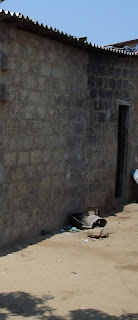
I was busy playing with the kids when our guide described the situation, but what I got out of it is that 10 people – 9 kids and 1 adult - live in a room that is about 10 feet x 10 feet (assumption: 1 foot = the size of my shoe) without any windows, without electricity, without running water – just a room made of 4 brick walls, a roof, and a door. In 2002, I shared a 5 bedroom house in San Diego with 4 other people (temporarily 5 other people). I cannot imagine living with double the number of people in less than 1/20th of the space. I can’t speak from experience, but I assume living in a US jail would be considered luxury when compared to living around here.
Family #2
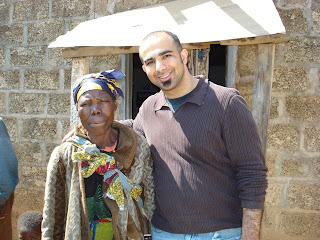
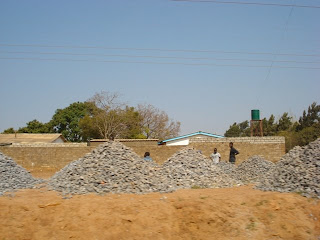
To a parent, I assume the most hurtful tragedy that can happen is the death of a child. Now, assume that you had 6 children, and that out of those 4 died, and 1 is critically ill. Further, assume that before they passed, each of the now dead children had children of their own, and that you and your spouse are now 100% responsible for your grandchildren. That is precisely what happened to a grandmother we visited. The youngest child she cares for is an infant, and it is HIV positive. Of course grandma, grandpa and (I believe 6) grandkids live in a very small home. For some grandmas out there, taking care of children would be fun, and for others it’s a reality. However, I hope that none of you grandparents out there have to “break rocks” for a living. This grandma does that for the family’s sole income. She goes out, finds big pieces of rocks, and then breaks them into small pieces. She mentioned that she sells a wheel barrel full of those rocks for 4 pin (=4,000 Kwacha = approximately $0.80). It has happened before that she only sells one wheel barrel per month, we’re told. Imagine what a “luxury” a dollar a day means to her. Meanwhile, I used to belong to a gym in Southern California, where I paid over $4 a day. This grandmother is one of the true heroes of this world.
Family #3
The word “family” is somewhat misleading here, but given that the people we visited don’t have anyone else, I still find it appropriate. We visited inner city street children. Our “guides” for this trip were a large group of outreach workers, who are helping these kids to get off the streets. Many of these helpers previously lived on the streets themselves, and have come a very long way. On the way to the beneficiaries, we had to pass through areas of town that I would certainly not cross by myself, and therefore, I did not dare to take out my camera – sorry!
Some of the kids (mostly teens) were high (I believe from sniffing glue) and all of them were dirty. We heard that some of the kids are sometimes violent, but my experience was that they are nice, and very excited to talk to us. In conversation with them, I found that a couple of them seemed smart, and a couple even seemed somewhat educated. The stories of how they ended up on the streets and why they are still on the streets are not very pleasant – obviously. One particular kid lost both parents and lived with his uncle, who regularly threatened to poison the boy. At one point the teen couldn’t handle it anymore and ran away.
Going on these trips was a true eye-opener for me, especially, when I compare it with life in Orange County, California. A good friend of mine lives in a nice condo in Irvine, and in the parking lot of his towers are several (!!!) Ferraris, Bentleys, and even a couple of Rolls Royces. I wonder how many people here can be helped with just the money it costs to insure these cars.
I hope that when I return to the States, I will not forget these trips. I hope to be able to keep these experiences with me for the rest of my life.
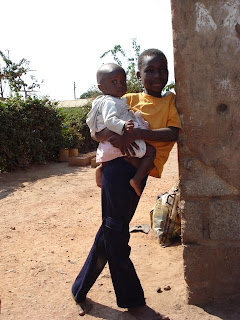
It's not unusual to see kids taking care of kids
A home for 10 people!!
Hero Grandmother
Goods the grandmother sells - broken rocks
As most of you know, the HIV/AIDS rate is rampant around here. Some estimates put areas of Lusaka at 20% and even above – That means 1 in 5 people is infected. Let’s assume that is extremely exaggerated, and reduce that rate by 50%, even then, 1 in 10 people is infected. Of course that is not the only killer. Healthcare is a serious problem here, and there are more problems all over…
Family #1
I was busy playing with the kids when our guide described the situation, but what I got out of it is that 10 people – 9 kids and 1 adult - live in a room that is about 10 feet x 10 feet (assumption: 1 foot = the size of my shoe) without any windows, without electricity, without running water – just a room made of 4 brick walls, a roof, and a door. In 2002, I shared a 5 bedroom house in San Diego with 4 other people (temporarily 5 other people). I cannot imagine living with double the number of people in less than 1/20th of the space. I can’t speak from experience, but I assume living in a US jail would be considered luxury when compared to living around here.
Family #2
To a parent, I assume the most hurtful tragedy that can happen is the death of a child. Now, assume that you had 6 children, and that out of those 4 died, and 1 is critically ill. Further, assume that before they passed, each of the now dead children had children of their own, and that you and your spouse are now 100% responsible for your grandchildren. That is precisely what happened to a grandmother we visited. The youngest child she cares for is an infant, and it is HIV positive. Of course grandma, grandpa and (I believe 6) grandkids live in a very small home. For some grandmas out there, taking care of children would be fun, and for others it’s a reality. However, I hope that none of you grandparents out there have to “break rocks” for a living. This grandma does that for the family’s sole income. She goes out, finds big pieces of rocks, and then breaks them into small pieces. She mentioned that she sells a wheel barrel full of those rocks for 4 pin (=4,000 Kwacha = approximately $0.80). It has happened before that she only sells one wheel barrel per month, we’re told. Imagine what a “luxury” a dollar a day means to her. Meanwhile, I used to belong to a gym in Southern California, where I paid over $4 a day. This grandmother is one of the true heroes of this world.
Family #3
The word “family” is somewhat misleading here, but given that the people we visited don’t have anyone else, I still find it appropriate. We visited inner city street children. Our “guides” for this trip were a large group of outreach workers, who are helping these kids to get off the streets. Many of these helpers previously lived on the streets themselves, and have come a very long way. On the way to the beneficiaries, we had to pass through areas of town that I would certainly not cross by myself, and therefore, I did not dare to take out my camera – sorry!
Some of the kids (mostly teens) were high (I believe from sniffing glue) and all of them were dirty. We heard that some of the kids are sometimes violent, but my experience was that they are nice, and very excited to talk to us. In conversation with them, I found that a couple of them seemed smart, and a couple even seemed somewhat educated. The stories of how they ended up on the streets and why they are still on the streets are not very pleasant – obviously. One particular kid lost both parents and lived with his uncle, who regularly threatened to poison the boy. At one point the teen couldn’t handle it anymore and ran away.
Going on these trips was a true eye-opener for me, especially, when I compare it with life in Orange County, California. A good friend of mine lives in a nice condo in Irvine, and in the parking lot of his towers are several (!!!) Ferraris, Bentleys, and even a couple of Rolls Royces. I wonder how many people here can be helped with just the money it costs to insure these cars.
I hope that when I return to the States, I will not forget these trips. I hope to be able to keep these experiences with me for the rest of my life.
It's not unusual to see kids taking care of kids

A home for 10 people!!

Hero Grandmother

Goods the grandmother sells - broken rocks

Monday, July 27, 2009
The Dutch Reform Market – Lusaka, Zambia
Another month is coming to an end. Time flies… especially around here.
Every Sunday, there is a craft market at a shopping center called Arcades, and every last Saturday of the month, there is a similar, but much bigger market in Kabulonga, less than a 5 min drive from our home. It is Lusaka’s biggest market, where vendors come to sell mostly handmade crafts. There are food and entertainment also, so there is something for everybody.
I find this market very enjoyable, mainly because I get the opportunity to bargain in a bazaar-like environment. Unfortunately, some of the vendors know us already, and therefore there is not much negotiation to be done. However, generally speaking, the following is the “normal” experience:
For anything one wants to buy, the seller dreams up a random number, and says it out loud. Thereafter, the negotiation begins, and after a few times back and forth the parties settle on a price that’s usually much less than a third of the originally quoted price.
I have come to the realization that most everything does have a standard price after all. The key is to offer the price you are willing to pay and to be prepared to walk away. I cannot tell you how often the sellers followed us after we left their area, to offer us the item we wanted at the price we wanted. Once you buy a few items you’ll get a good feel for it, but it takes some “experience”. Of course, that makes tourists very vulnerable to overpaying, but they often feel that they have gotten a “deal” anyway, because they negotiated the price down a little bit. As long as everybody is happy, it’s all good.
After the “shopping” is done, we usually go to the food section of the market. There is a great variety of international foods. Probably the most famous vendor in the market is the “noodle lady”, who reminds me of Seinfeld’s “Soup Nazi”, but I don’t particularly enjoy her noodles. I am a big fan of the Polish family!!! Boereworst (no idea how you spell that) is my favorite. Not only is the meat prepared at home, but they also offer all sorts of homemade sauces.
The market is yet another event that makes our stay in Lusaka very memorable. Here are a few pictures of various parts of the market:
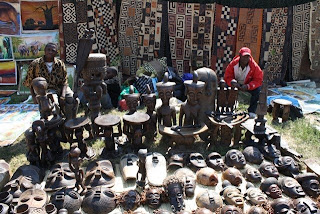


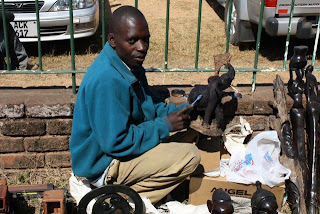
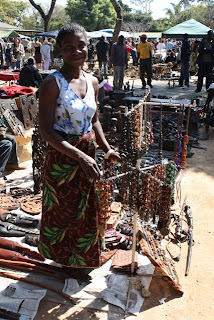
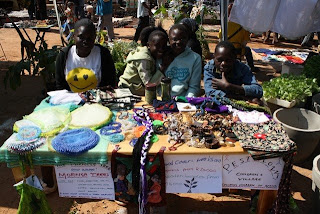

Hippos are VERY popular!!
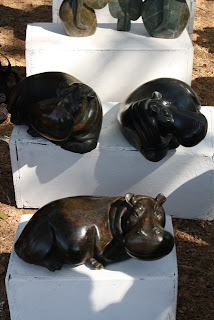
My "dream hippos" weigh a LOT!!

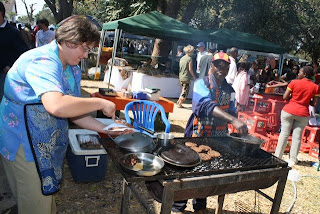
The "noodle lady" & associates

Every Sunday, there is a craft market at a shopping center called Arcades, and every last Saturday of the month, there is a similar, but much bigger market in Kabulonga, less than a 5 min drive from our home. It is Lusaka’s biggest market, where vendors come to sell mostly handmade crafts. There are food and entertainment also, so there is something for everybody.
I find this market very enjoyable, mainly because I get the opportunity to bargain in a bazaar-like environment. Unfortunately, some of the vendors know us already, and therefore there is not much negotiation to be done. However, generally speaking, the following is the “normal” experience:
For anything one wants to buy, the seller dreams up a random number, and says it out loud. Thereafter, the negotiation begins, and after a few times back and forth the parties settle on a price that’s usually much less than a third of the originally quoted price.
I have come to the realization that most everything does have a standard price after all. The key is to offer the price you are willing to pay and to be prepared to walk away. I cannot tell you how often the sellers followed us after we left their area, to offer us the item we wanted at the price we wanted. Once you buy a few items you’ll get a good feel for it, but it takes some “experience”. Of course, that makes tourists very vulnerable to overpaying, but they often feel that they have gotten a “deal” anyway, because they negotiated the price down a little bit. As long as everybody is happy, it’s all good.
After the “shopping” is done, we usually go to the food section of the market. There is a great variety of international foods. Probably the most famous vendor in the market is the “noodle lady”, who reminds me of Seinfeld’s “Soup Nazi”, but I don’t particularly enjoy her noodles. I am a big fan of the Polish family!!! Boereworst (no idea how you spell that) is my favorite. Not only is the meat prepared at home, but they also offer all sorts of homemade sauces.
The market is yet another event that makes our stay in Lusaka very memorable. Here are a few pictures of various parts of the market:


Last minute touches


Hippos are VERY popular!!

My "dream hippos" weigh a LOT!!

The "noodle lady" & associates

My #1.... COOK!!!

Wednesday, July 15, 2009
The "Real" Zambia
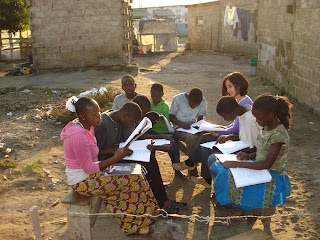
As part of the Baha’i activities we engage in, we hold junior youth empowerment classes on the weekends that we don't travel. On average, about 20– 25 junior youth (ages about 10 to about 17) attend. Although generally junior youth classes are more focused on individual and spiritual development, these particular classes feel more like us helping kids to learn/improve their reading skills. I am more than happy to do that, as I believe that education is an essential step in the continued development of this country. The class is held at a compound, right outside of the kids’ homes, and life in compounds is what I’d like to describe in this post.
Before coming to Zambia, I always thought highly of compounds. In my mind, I pictured exclusive areas of town, where expats occupied big mansions. I imagined a tall wall around the complex secured with barbwires and cameras and military personnel guarding all gates.
Well, compounds here are just about the exact opposite. The majority of Lusaka’s population lives in compounds, and we have yet to see a single non-local, other than ourselves, when we visit. There are several compounds around town, and from what I have seen they are very similar.
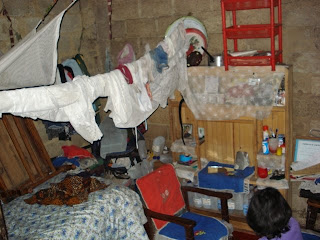
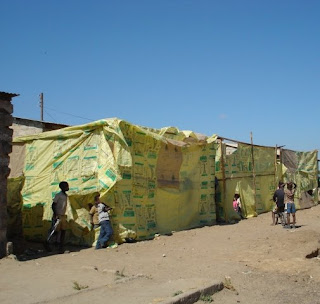
Most homes are made of small one or two room brick buildings. Each one is comparable to the size of the office I had back in the States (although I did stay in the office until morning hours (during budget season) I never considered fully moving in). Sometimes a few homes are attached, and many don’t have any windows. Several people live in one room. That one room functions as the master bedroom, children bedrooms, family room and dining room. The “kitchen”, “restroom” and “showers” are located outside. The kitchen is made up of one or two small, portable fire pits that are powered by charcoal. The restroom is located somewhere outside of the homes, and is shared by several families. Finally, I have yet to see a shower. I have seen people use buckets of water to wash themselves, so I assume that’s how most of the locals shower.
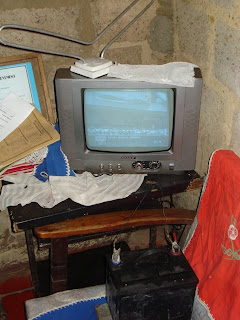
Further, electricity is not available in most homes. Overall, we heard that less than one third of the population has access to electricity (and the population that does have access, loses power on a regular basis). The last home we visited had an old, small, black and white TV, powered by a car battery.
Outside, trash is often compiled in mini-landfills and dogs, chickens and sometimes goats roam around.
About 80% of kids run around bare feet. During our last visit, we saw a small group of them make a fire and play with its ashes – painting their faces with it. Some children use “metal strings” as toys. One kid attached such a string to an empty plastic gas-container and pretended it was a car. A few boys played football (soccer) by using what appeared to be a bunch of rolled up plastic bags as a ball.
Grown-ups are also around of course. In between the densely constructed “homes” are small markets, where one can buy fruits, vegetables, clothes, live chickens, and pretty much anything else you can imagine – with respect to life’s basic necessities, of course. You also see iron workers - usually they are making burglar bars, or simple frames for doors and windows - and “stone-workers” – people use hammers and other tools to “shred” big stones to different sizes. In addition, there are also bars and clubs in the middle of everything, which means that there are a few drunks running around (let’s not talk about financial management). Overall, however, I feel that people are very friendly, especially towards us muzungus (“non-locals”). A lot of them gather round to look at us. Most are curious to see why we are there.
During classes, which are held outdoors, of course, we get several interruptions, mainly by men wanting to “talk to me in private” (not sure if they want to kidnap me or offer me something to buy) and a few curious people who interrupt the class just to talk to us.
Although I am very impressed by the students, as they make an effort to make a difference in their own lives, I am also very concerned about the future of most of them, given their poor reading skills. Even the 12 or 13 year olds can barely read simple sentences. All of them seem happy to have this opportunity to get together and practice reading, and most participate actively.
Based on what I see, I assume that many of these kids cannot afford schools, or that the schools they attend aren’t effective. The experience of interacting with these kids, along with the experience gathered through volunteering for PCI and visiting its partners, has inspired Azadeh to start taking steps toward starting an NGO that would build schools and provide financial aid to students who need it most.
One of the classes

Behind the class is a "store", and to the left, well, mostly trash
The building behind the class = four homes

The inside of one of the homes
Creative!!
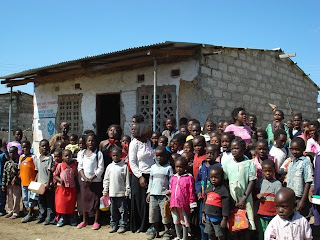
This is a school!!!
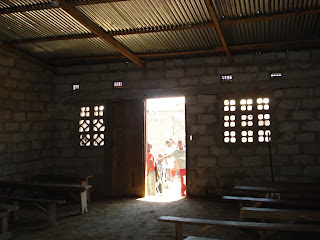
No electricity and no "real" windows
Students sang a welcome song
Lunch Time + Camera! Look at each individual happy face!

Restrooms for a school with OVER 250 students
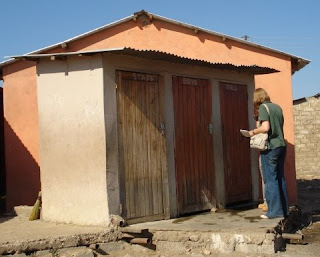
Before coming to Zambia, I always thought highly of compounds. In my mind, I pictured exclusive areas of town, where expats occupied big mansions. I imagined a tall wall around the complex secured with barbwires and cameras and military personnel guarding all gates.
Well, compounds here are just about the exact opposite. The majority of Lusaka’s population lives in compounds, and we have yet to see a single non-local, other than ourselves, when we visit. There are several compounds around town, and from what I have seen they are very similar.
Most homes are made of small one or two room brick buildings. Each one is comparable to the size of the office I had back in the States (although I did stay in the office until morning hours (during budget season) I never considered fully moving in). Sometimes a few homes are attached, and many don’t have any windows. Several people live in one room. That one room functions as the master bedroom, children bedrooms, family room and dining room. The “kitchen”, “restroom” and “showers” are located outside. The kitchen is made up of one or two small, portable fire pits that are powered by charcoal. The restroom is located somewhere outside of the homes, and is shared by several families. Finally, I have yet to see a shower. I have seen people use buckets of water to wash themselves, so I assume that’s how most of the locals shower.
Further, electricity is not available in most homes. Overall, we heard that less than one third of the population has access to electricity (and the population that does have access, loses power on a regular basis). The last home we visited had an old, small, black and white TV, powered by a car battery.
Outside, trash is often compiled in mini-landfills and dogs, chickens and sometimes goats roam around.
About 80% of kids run around bare feet. During our last visit, we saw a small group of them make a fire and play with its ashes – painting their faces with it. Some children use “metal strings” as toys. One kid attached such a string to an empty plastic gas-container and pretended it was a car. A few boys played football (soccer) by using what appeared to be a bunch of rolled up plastic bags as a ball.
Grown-ups are also around of course. In between the densely constructed “homes” are small markets, where one can buy fruits, vegetables, clothes, live chickens, and pretty much anything else you can imagine – with respect to life’s basic necessities, of course. You also see iron workers - usually they are making burglar bars, or simple frames for doors and windows - and “stone-workers” – people use hammers and other tools to “shred” big stones to different sizes. In addition, there are also bars and clubs in the middle of everything, which means that there are a few drunks running around (let’s not talk about financial management). Overall, however, I feel that people are very friendly, especially towards us muzungus (“non-locals”). A lot of them gather round to look at us. Most are curious to see why we are there.
During classes, which are held outdoors, of course, we get several interruptions, mainly by men wanting to “talk to me in private” (not sure if they want to kidnap me or offer me something to buy) and a few curious people who interrupt the class just to talk to us.
Although I am very impressed by the students, as they make an effort to make a difference in their own lives, I am also very concerned about the future of most of them, given their poor reading skills. Even the 12 or 13 year olds can barely read simple sentences. All of them seem happy to have this opportunity to get together and practice reading, and most participate actively.
Based on what I see, I assume that many of these kids cannot afford schools, or that the schools they attend aren’t effective. The experience of interacting with these kids, along with the experience gathered through volunteering for PCI and visiting its partners, has inspired Azadeh to start taking steps toward starting an NGO that would build schools and provide financial aid to students who need it most.
One of the classes

Behind the class is a "store", and to the left, well, mostly trash

The building behind the class = four homes

The inside of one of the homes

Creative!!

This is a school!!!

No electricity and no "real" windows

Students sang a welcome song

Lunch Time + Camera! Look at each individual happy face!

Restrooms for a school with OVER 250 students

Tuesday, July 7, 2009
What a weekend!! - South Luangwa, Zambia
Last weekend, we experienced what will likely be the “touristy highlight” of our stay in Zambia. We visited South Luangwa National Park, the most famous “safari destination” in Zambia (and maybe even in this region of Africa). Initially, we wanted to go to Zanzibar over the long weekend, and had planned on visiting South Luangwa in August, when it is warmer, in order to improve our chances of seeing animals (cats in particular). However, the travel agent talked us into changing our plans.
Travel
Although the flights by themselves were “normal”, the procedures were anything but “normal” from an American standpoint. We didn’t have any tickets or “confirmation numbers”, just itineraries. Once we arrived at the airport we walked through metal detectors, as is normal in the States and pretty much anywhere else I have been. However, on the way back, the detector went off when I walked through. No one cared, and then, the “guard” even left his post, and people just walked through the metal detector. It went off several times, and still…no one cared. Once on the flight, the first thing I noticed, is that the cockpit door was missing, which means that everyone had “easy access” to the cockpit. Although initially I was very uncomfortable about that, once we were in the air, I took advantage of this opportunity by moving to the seat right behind the pilots, and watched them operate for most of the flight.
To top things off, here is the most surprising fact: The entire trip (= at Lusaka Airport, at the Hotel and at Mfuwe Airport) no one asked any of us for any kind of ID (not even once). Anyone could have taken this trip instead of us, and it would have been just fine. Although these facts show “serious” lack of security, they also show that there is no need for “proper” security.
Lodge
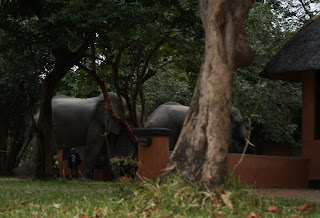
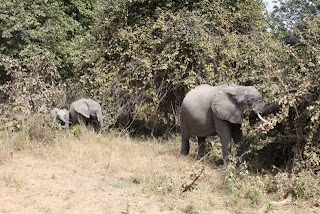
Our lodge was located a couple of miles outside of the National Park, but had several wild animals on and around the property – Monkeys and baboons were all over, and just waited for opportunities to feed off of people’s leftovers, if the waiters didn’t clean up in time. We also saw two big elephants on property – as in between rooms that people were staying in. Further, from the “eating area”, we saw two hippos, and several antelopes.
Game Drives
We went on four game drives (= safaris) which lasted several hours each. This meant waking up around 5:00 am each day, but I (not so sure about “we”) was happy to do that. We left the property when it was still dark, and when it was very cold.
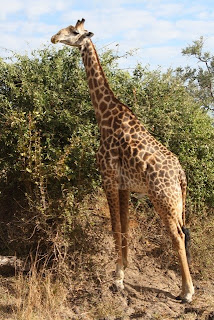
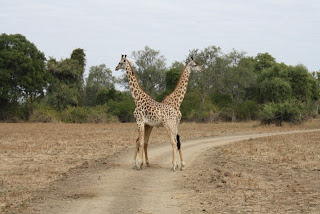
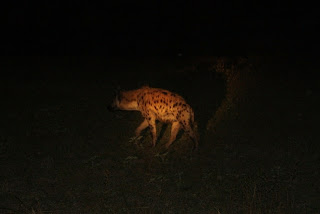
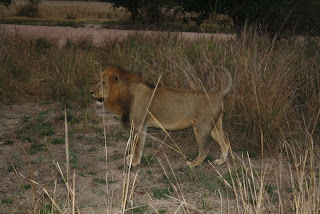
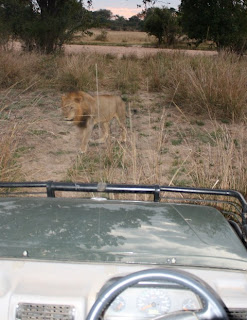
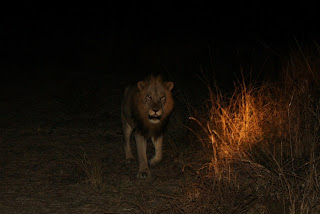
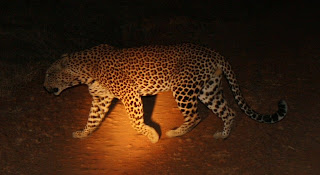
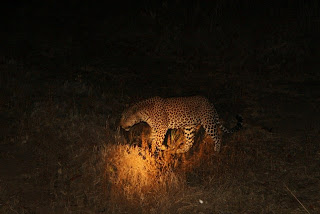
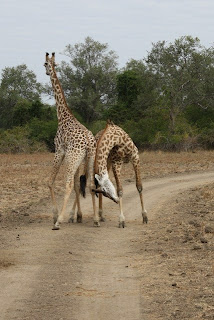
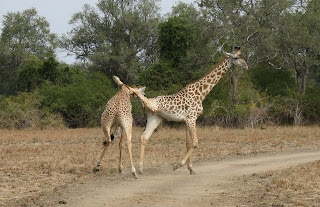
Each of us had our own “animal of choice” we wanted to see: Ketsia – Hyena (which later changed to “Pumba” (aka warthog)), Kathleen – Giraffes, Azadeh – Leopards, and me – Lions. Everybody was a winner. Kathleen more so than the others, not only because we saw a lot of giraffes, but mainly because we saw two giraffes fight, which was quite interesting. From another point of view Azadeh was the “main winner”, as it is much rarer to see leopards, than it is to see any of the other animals. Some people have been staying at the lodge for over a week, and have not seen any leopards.
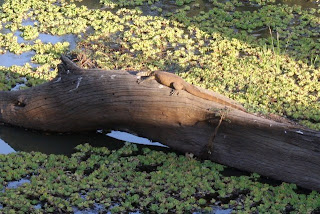
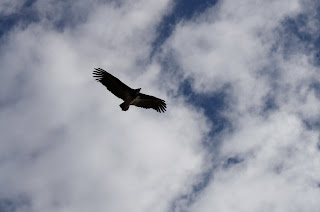
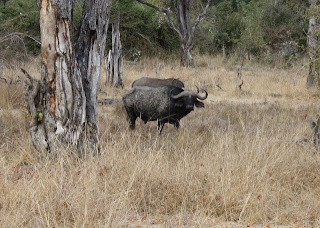
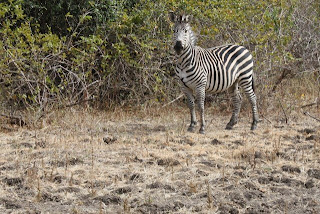
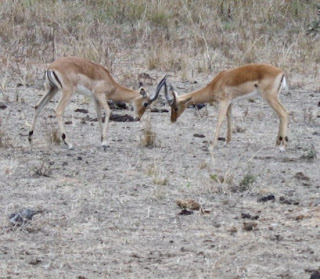
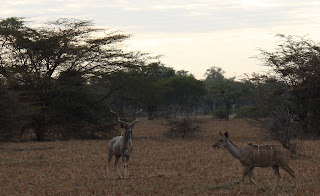
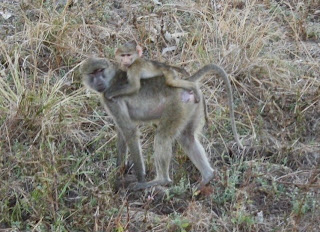
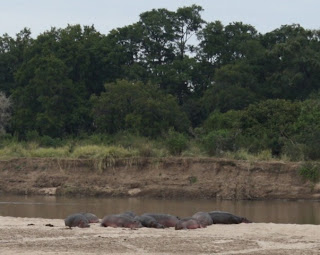
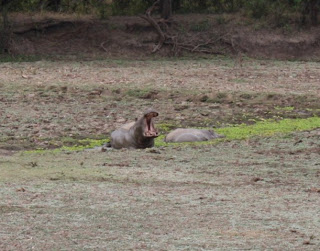
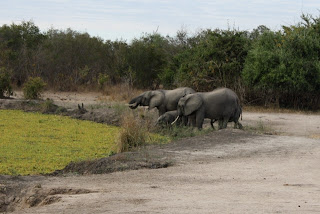
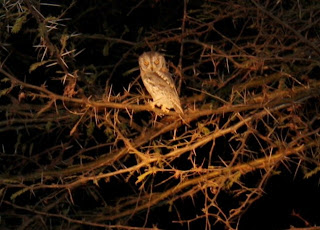
Overall, we saw plenty of animals. Here is a list of a “few” of them: Hippos, elephants, buffalos, giraffes, hyenas, impalas, crocs, monkeys, baboons, warthogs, eagles, zebras, lions, and a leopard.
Big thanks to Willy, the main guide/driver, and to John the “spotter”. They were excellent. Willy has been doing this for almost 15 years, and drove through all sorts of terrains to get us to see animals.
I took well over a thousand pictures (remember the “film” days, when we only had 24 or 36 pictures to snap per roll?!). Here are a few of them:
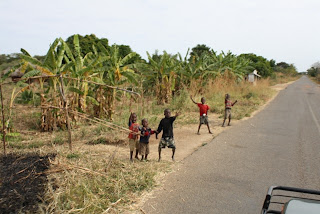
Kids welcoming us - on the way to the lodge
Our rooms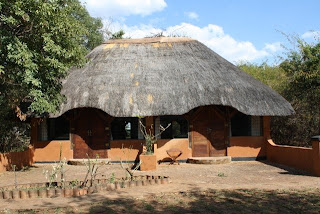
A little too close for comfort, at least when we're not in a vehicle
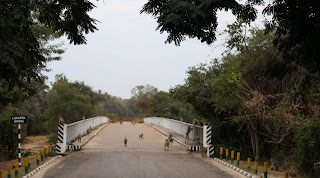
Here's the entrance to the park
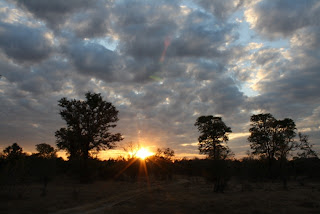
Beautiful Sunset
Beautiful SunRISE
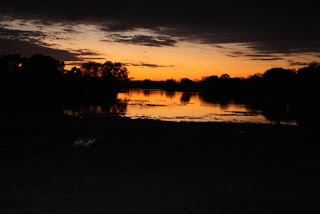
Looks so peaceful, doesn't it?!
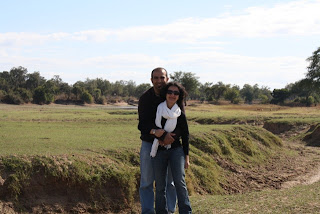
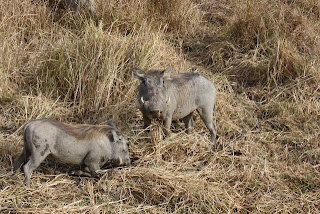
Here is "Pumba":

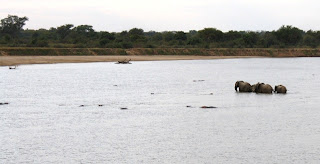
Can you see all three elephants?
Go Rice!!!!

Travel
Although the flights by themselves were “normal”, the procedures were anything but “normal” from an American standpoint. We didn’t have any tickets or “confirmation numbers”, just itineraries. Once we arrived at the airport we walked through metal detectors, as is normal in the States and pretty much anywhere else I have been. However, on the way back, the detector went off when I walked through. No one cared, and then, the “guard” even left his post, and people just walked through the metal detector. It went off several times, and still…no one cared. Once on the flight, the first thing I noticed, is that the cockpit door was missing, which means that everyone had “easy access” to the cockpit. Although initially I was very uncomfortable about that, once we were in the air, I took advantage of this opportunity by moving to the seat right behind the pilots, and watched them operate for most of the flight.
To top things off, here is the most surprising fact: The entire trip (= at Lusaka Airport, at the Hotel and at Mfuwe Airport) no one asked any of us for any kind of ID (not even once). Anyone could have taken this trip instead of us, and it would have been just fine. Although these facts show “serious” lack of security, they also show that there is no need for “proper” security.
Lodge
Our lodge was located a couple of miles outside of the National Park, but had several wild animals on and around the property – Monkeys and baboons were all over, and just waited for opportunities to feed off of people’s leftovers, if the waiters didn’t clean up in time. We also saw two big elephants on property – as in between rooms that people were staying in. Further, from the “eating area”, we saw two hippos, and several antelopes.
Game Drives
We went on four game drives (= safaris) which lasted several hours each. This meant waking up around 5:00 am each day, but I (not so sure about “we”) was happy to do that. We left the property when it was still dark, and when it was very cold.
Each of us had our own “animal of choice” we wanted to see: Ketsia – Hyena (which later changed to “Pumba” (aka warthog)), Kathleen – Giraffes, Azadeh – Leopards, and me – Lions. Everybody was a winner. Kathleen more so than the others, not only because we saw a lot of giraffes, but mainly because we saw two giraffes fight, which was quite interesting. From another point of view Azadeh was the “main winner”, as it is much rarer to see leopards, than it is to see any of the other animals. Some people have been staying at the lodge for over a week, and have not seen any leopards.
Overall, we saw plenty of animals. Here is a list of a “few” of them: Hippos, elephants, buffalos, giraffes, hyenas, impalas, crocs, monkeys, baboons, warthogs, eagles, zebras, lions, and a leopard.
Big thanks to Willy, the main guide/driver, and to John the “spotter”. They were excellent. Willy has been doing this for almost 15 years, and drove through all sorts of terrains to get us to see animals.
I took well over a thousand pictures (remember the “film” days, when we only had 24 or 36 pictures to snap per roll?!). Here are a few of them:
Kids welcoming us - on the way to the lodge

Our rooms

A little too close for comfort, at least when we're not in a vehicle


Look below the elephant on the left!

Here's the entrance to the park

Beautiful Sunset

Beautiful SunRISE

Looks so peaceful, doesn't it?!


Here is "Pumba":


This is what a "giraffe fight" looks like

That must hurt! Right on the "knee"

Almost got the K.O., but not quite
How many crocs are in the picture below?

How many crocs are in the picture below?


Can you see all three elephants?


Go Rice!!!!


Wildlife "Everywhere" - Literally ;)

Subscribe to:
Posts (Atom)